
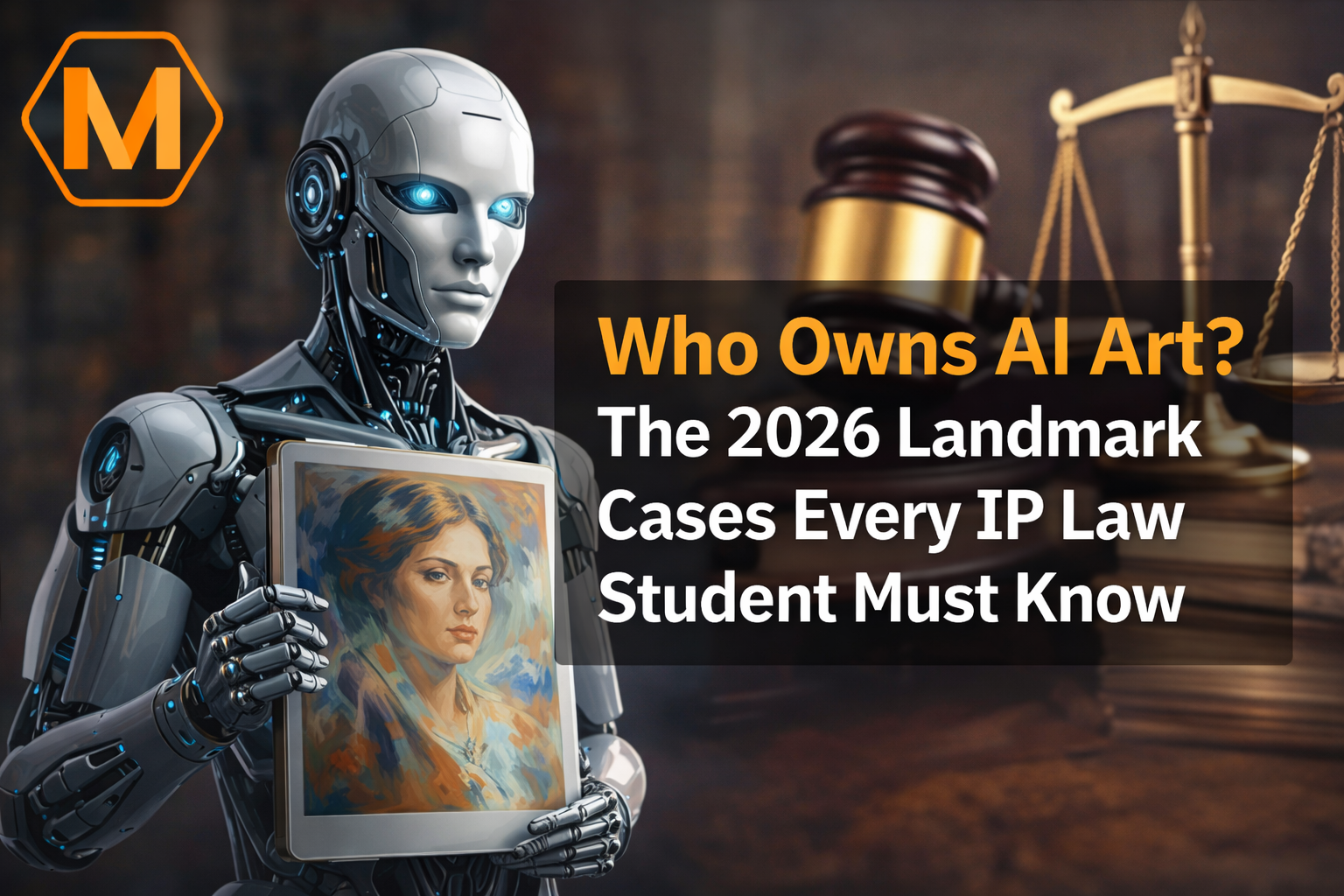
The intersection of generative artificial intelligence and intellectual property law has shifted from a theoretical debate to a high-stakes courtroom reality. For law students entering the field in 2026, the question of “authorship” is no longer just about who held the pen, but who prompted the machine. As the digital landscape evolves, understanding the nuances of copyright eligibility for AI-generated works is essential for anyone looking to practice in tech, entertainment, or corporate law. We are currently witnessing a legal transformation where statutes written in the 1970s are being stretched to cover neural networks and diffusion models.
Navigating these complex legal shifts requires more than just reading a textbook; it demands a granular analysis of real-time judicial rulings and administrative shifts. Many students find that balancing these deep-dive research projects with a full course load is overwhelming, leading them to seek Assignment Help Online from experts at myassignmenthelp to ensure their case briefs are both accurate and structurally sound. This collaborative approach allows future lawyers to focus on the philosophical and societal implications of these cases while ensuring their academic submissions meet the rigorous standards of 2026 legal pedagogy.
1. The Death of the “Prompt-as-Authorship” Theory
The primary battleground in 2026 remains the Human Authorship Requirement. Early arguments suggested that because a human wrote the prompt, the resulting image was a “work made for hire” by the AI. However, the landmark ruling in Loomis v. Copyright Office (2025) clarified that “procedural guidance” does not equal “creative control.” The court famously noted that “an architect who describes a house to a builder does not become the carpenter; likewise, a prompter who describes a scene to an algorithm does not become the artist.”
For a law student, this distinction is vital: without “specific, identifiable human intervention” in the output—such as manual digital painting over an AI base or significant structural manipulation—the work remains in the public domain. This has led to the “De Minimis” debate: how much human tweaking is required to move a work from “AI-generated” to “Human-assisted”?
2. The 2026 “Style Squatting” Precedents
One of the most controversial topics this year is the concept of “Style Copyright.” Traditionally, IP law dictates that you cannot copyright an artistic style, only a specific tangible work. However, new litigation involving AI models trained specifically on the living portfolios of contemporary artists has challenged this ancient pillar.
In the case of Vance v. NeuralSynth, the plaintiffs argued that “algorithmic mimicking” constitutes a new form of digital identity theft. The court had to decide if an AI model that can perfectly replicate a specific artist’s aesthetic violates the Right of Publicity, even if it doesn’t copy a specific pixel from a specific image. This case is a mandatory study for IP students because it marks the first time “statistical probability” and “latent space proximity” were used as forensic evidence of infringement.
3. The Fair Use Defense in the Age of Large Datasets
The “Fair Use” doctrine is being rewritten in real-time. The massive datasets used to train models like Midjourney, DALL-E 3, and their 2026 successors rely on billions of copyrighted images scraped from the open web. The legal question is whether this “scraping” is “transformative” enough to bypass copyright claims.
The 2026 Supreme Court clarification in ArtData Corp v. Creative Guild established the Market Substitution Test. If an AI model can generate a work that directly competes with the original artist’s market (e.g., an AI generator specifically marketed to replace “Indie Comic Book Artists”), the “Fair Use” defense fails. This has led to the rise of mandatory licensing pools, similar to how the music industry handles mechanical royalties through organizations like ASCAP or BMI.
4. Navigating the Jurisdictional Split
Global law students must realize that “ownership” changes the moment you cross a digital border. While the U.S. maintains a strict human-centric view, other jurisdictions, particularly in Southeast Asia and parts of the Middle East, are experimenting with “Sui Generis” (unique) protections for computer-generated works. This creates a massive headache for international corporations that use AI for global branding, as a logo might be protected in Singapore but free for anyone to use in New York.
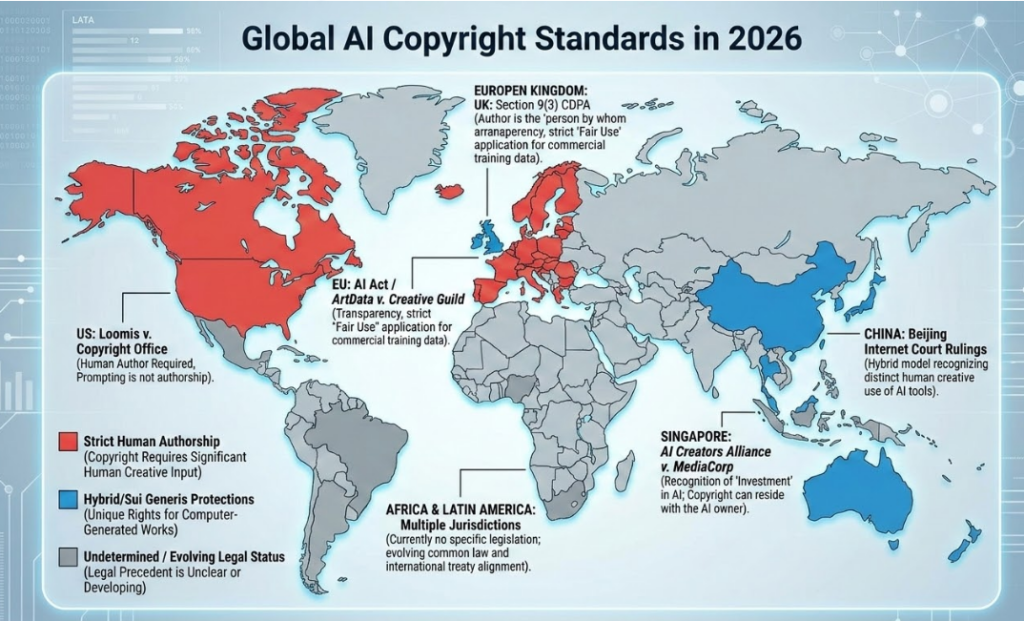
Understanding these international conflicts is a core component of modern legal education, especially for those interested in international trade law. Given the complexity of comparing EU AI Acts, US precedents, and evolving Asian IP statutes, many scholars utilize specialized Law Assignment Help to keep their comparative law essays updated with the latest 2026 treaty changes and trade agreement riders.
5. The “Significant Human Control” Test: The 20% Rule
So, how much “human touch” is actually enough to secure a copyright? In early 2026, the Copyright Office introduced the 20% Manual Modification Rule. To register a work that utilized AI, the applicant must demonstrate that at least 20% of the final pixels or structural elements were modified through human “non-algorithmic” effort. This is often called the “Human-in-the-Loop” standard.
Key Evidence for Students to Track in Case Files:
- Prompt Logs: Showing the iterative process of refining an image through hundreds of variations.
- Layer Data: Proving manual adjustments in software like Photoshop or Procreate.
- Hybridization: Evidence of merging AI elements with traditional photography, hand-drawn sketches, or physical textures.
6. The Rise of “Output Liability”
Ownership isn’t just about collecting royalties; it’s about who takes the blame when things go wrong. If an AI generates an image that accidentally looks exactly like a trademarked character or a private individual’s likeness, who pays the fine?
The 2026 ruling in BrandShield v. OpenGen placed the liability squarely on the User, not the software developer. This shift means that future IP lawyers will spend a significant portion of their time “clearing” AI assets—checking them against global trademark databases to ensure no accidental infringement has occurred. This has created a massive new job market for “AI Compliance Officers” within major law firms.
7. Why the “Public Domain” is Growing
Because so much AI art cannot be copyrighted under current US law, we are seeing an unprecedented explosion of the Public Domain. In 2026, major stock photo sites are now 90% AI-generated and, legally, 100% free to use for any purpose. This is crashing the traditional stock photography market but providing a goldmine for small businesses and creators who don’t need exclusive ownership.
For the IP law student, the “Public Domain” is no longer just where 19th-century books go to die; it is a living, breathing part of the modern digital economy. Learning how to advise clients on using these “unownable” assets without accidentally infringing on “hidden” trademarks within the images is a crucial 21st-century legal skill.
8. Algorithmic Disgorgement: The “Death Penalty” for Models
A new legal term every law student must master in 2026 is Algorithmic Disgorgement. This is a court-ordered “unlearning” process. If a model is found to have been trained on illegally obtained data, the court can order the developer to delete the model entirely and start over.
This happened in the PhotoRefinery v. VisionAI case, where the company lost a three-billion-dollar model because they couldn’t prove the “provenance” of their training data. This makes data auditing one of the most important aspects of corporate law today.
Comparison of Major 2026 AI Legal Frameworks
| Jurisdiction | Authorship Status | Ownership Threshold | Primary Legal Focus |
| United States | Human Only | “Significant” Human Input (20% Rule) | Incentivizing human creators. |
| European Union | Human Only | Transparency & Data Provenance | Consumer protection and ethics. |
| China | Hybrid | Recognition of “Investment” in AI | Economic growth and tech leadership. |
| United Kingdom | Computer-Generated | “The person by whom arrangements are made” | Commercial certainty for developers. |
9. The Ethical Responsibility of the Modern Lawyer
Beyond the statutes and the case numbers lies a deep ethical question: Is the law meant to protect the “creator” or the “process”? As a student, you must grapple with whether the law should prioritize the blood, sweat, and tears of human effort or the efficiency and output of technological progress.
Many law schools have now introduced “AI Ethics and Machine Logic” as a core requirement for graduation. The consensus in 2026 is that the law must find a middle ground—protecting the livelihoods of human artists through “opt-out” registries while allowing the immense creative potential of AI to flourish in non-commercial or transformative spaces.
10. Practical Advice for 2026 Law Grads
If you are graduating this year, your value does not lie in your ability to memorize the Copyright Act. Your value lies in your ability to perform Forensic Prompt Auditing. You must be able to look at a client’s workflow and determine if their use of AI is “safe” for copyright or if they are sitting on a legal time bomb.
3 Things to Check in Every AI IP Audit:
- Terms of Service (ToS): Did the AI tool used by the client claim ownership of the output in its fine print?
- Training Data Provenance: Can the developer prove the model wasn’t trained on “poisoned” or non-consensual data?
- Human Contribution Log: Is there a clear paper trail of how the human artist modified the AI’s initial output?
Conclusion: Preparing for a Post-Human IP Landscape
The 2026 landmark cases have shown us that the law is a slow-moving giant trying to catch a lightning-fast digital fox. For every new ruling, three new technologies emerge that challenge it. As a law student, your value lies not in knowing the “right” answer—because the answer changes every six months—but in understanding the logic of the precedents.
The definition of “Art” may stay the same, but the definition of “Owner” is in a state of permanent flux. Whether you are helping a startup protect its AI-generated branding or defending an artist against algorithmic scraping, you are at the forefront of the most exciting legal frontier in a century. Stay curious, stay updated, and always look for the human element in the code.
Frequently Asked Questions
Can I copyright an image generated entirely by AI?
As of 2026, the global legal standard generally requires a “human authorship” element. If a work is created solely through an algorithm without significant human creative intervention, it typically cannot be registered for copyright and remains in the public domain.
What is the “Human-in-the-Loop” requirement?
This legal test determines if a human exercised enough creative control over the AI’s output to claim ownership. Courts often look for evidence of manual digital editing, specific structural changes, or iterative refinements that demonstrate the human—not the machine—made the final creative decisions.
Is it legal for AI models to train on my personal artwork?
Current 2026 precedents focus on “Transformative Use.” While many models scrape public data, new regulations in multiple jurisdictions allow artists to “opt-out” or require developers to pay licensing fees if the AI’s output directly competes with the original creator’s market.
Who is liable if an AI-generated image infringes on a trademark?
Recent landmark rulings have shifted the burden of liability onto the user who generated and published the content. It is the responsibility of the creator to perform a “clearing” process to ensure the output does not accidentally mimic protected intellectual property.