

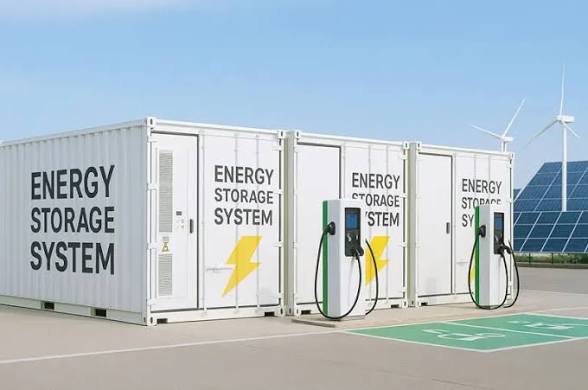
As global energy systems continue to transition toward renewable sources, the importance of large-scale energy storage has become increasingly evident. Container energy storage systems (ESS), particularly large-scale liquid-cooled solutions, are emerging as a critical technology for enhancing grid stability, supporting renewable integration, and improving energy efficiency across industrial and utility-scale applications.
The growing share of intermittent energy sources such as solar and wind has created new challenges for grid operators. Energy storage systems provide the flexibility needed to balance supply and demand, making them a foundational component of modern power infrastructure.
What Is a Container Energy Storage System?
A containerized energy storage system is a fully integrated solution that combines battery storage, power conversion, thermal management, and control systems within a standardized shipping container. These systems are typically based on lithium iron phosphate (LFP) batteries, known for their safety, long lifecycle, and thermal stability.
Unlike traditional energy infrastructure, containerized systems are designed for rapid deployment. They can be transported to project sites, installed with minimal civil work, and commissioned within a relatively short timeframe. This modularity makes them especially attractive for projects requiring scalability or phased expansion.
Compared to smaller or distributed storage units, containerized ESS solutions offer higher energy density and better integration capabilities. Their standardized design also simplifies logistics, installation, and maintenance, reducing overall project complexity.
Battery Architecture and System Design
The performance of large-scale energy storage systems heavily depends on their internal battery configuration and system architecture. High-voltage configurations are commonly used to improve efficiency and reduce system losses in utility-scale applications. By operating at higher voltages, systems can reduce current flow, minimizing resistive losses and improving overall efficiency.
Battery modularization enables flexible scaling and simplifies maintenance. Instead of replacing an entire system, individual modules can be serviced or replaced, reducing downtime and operational costs. Advanced battery management systems (BMS) monitor cell performance in real time, ensuring operational safety and extending system lifespan.
In addition, modern ESS platforms often incorporate energy management systems (EMS) that optimize charging and discharging strategies based on grid conditions, electricity pricing, and load demand. These intelligent control systems are increasingly important as energy storage becomes more integrated with digital energy networks.
Technical Challenges in Large-Scale Energy Storage
Despite their advantages, deploying large-scale ESS systems presents several technical challenges:
- Maintaining thermal stability under high energy density conditions
- Ensuring battery consistency over long operational cycles
- Integrating multiple subsystems into a unified control architecture
- Managing safety risks such as overheating or thermal runaway
As system capacity increases, these challenges become more complex. Even small variations in temperature or cell performance can impact overall system reliability. Therefore, system design must prioritize uniformity, monitoring accuracy, and fault response capabilities.
Addressing these challenges requires continuous innovation in materials, system engineering, and control technologies. Industry standards and safety certifications also play a crucial role in ensuring reliable deployment.
Advantages of Liquid Cooling Technology
Liquid cooling has become a preferred thermal management solution for high-capacity energy storage systems. Compared to traditional air cooling, liquid cooling provides more efficient and precise temperature control, which is essential for maintaining battery performance and safety.
Key benefits include:
- More uniform temperature distribution across battery modules
- Higher heat dissipation efficiency, especially in dense systems
- Extended battery lifecycle, often exceeding 8000 cycles
- Improved system safety through precise thermal control
- Higher overall energy efficiency
By maintaining a stable operating temperature, liquid cooling reduces degradation and improves long-term reliability. This is particularly important in large-scale systems where thermal imbalances can lead to performance losses or safety risks.
Applications in Modern Energy Systems
Container energy storage systems are widely applied in various scenarios:
- Utility-scale grid support, including frequency regulation and peak shaving
- Renewable energy integration, such as solar-plus-storage and wind-plus-storage projects
- Commercial and industrial energy optimization, reducing electricity costs and improving energy resilience
- Microgrid and off-grid systems, enabling stable power supply in remote areas
- Backup power solutions for critical infrastructure like data centers and hospitals
In many regions, energy storage is also being used to support energy trading and demand response programs. By storing energy during low-cost periods and discharging during peak demand, businesses can optimize energy costs while contributing to grid stability.
The Importance of Choosing the Right Energy Storage Partner
As energy storage technologies continue to evolve, selecting a reliable partner becomes increasingly important for ensuring long-term system performance and project success. A qualified supplier not only provides standardized equipment but also offers system integration capabilities, customization options, and ongoing technical support.
Companies across the industry are actively developing containerized and liquid-cooled ESS solutions. For example, some energy storage supplier providers focus on system safety, lifecycle optimization, and flexible deployment to support both commercial and utility-scale applications.
Beyond product quality, factors such as project experience, engineering capabilities, and after-sales support are critical when evaluating potential partners.
Cost Considerations
The cost of a container energy storage system depends on multiple factors, including battery technology, cooling method, system configuration, and project-specific requirements.
Pricing is typically provided based on international trade terms such as EXW or FOB and varies depending on customization level, transportation conditions, and installation complexity. In addition, lifecycle costs—including maintenance, efficiency losses, and battery replacement—should be considered when evaluating total investment.
As manufacturing scales and technology advances, the cost of energy storage continues to decline, improving its economic viability across more applications.
Future Outlook
With the rapid growth of renewable energy and increasing demand for grid flexibility, large-scale energy storage systems are becoming essential infrastructure worldwide. Governments and utilities are increasingly incorporating storage into long-term energy planning to enhance grid resilience and reduce carbon emissions.
Advances in battery technology, thermal management, and intelligent control systems will further enhance system performance and reliability. Emerging trends such as hybrid energy systems, digital energy management, and AI-driven optimization are expected to shape the next generation of energy storage solutions.
Container energy storage systems represent a mature, scalable, and future-oriented solution that aligns with global energy transition goals. As the industry continues to evolve, their role in enabling a more stable, efficient, and sustainable energy system will only become more significant.